
How to Increase Brix Degrees and Improve the Commercial Quality of Your Harvest
In modern agriculture, fruit quality is just as important as yield. More and more markets demand produce with better flavor, improved coloration, longer shelf life, and a more uniform appearance. All these characteristics are closely linked to a key indicator during the ripening stage: Brix degrees.
An adequate sugar content not only enhances the fruit's organoleptic characteristics but also increases its commercial value. However, achieving optimal °Brix levels depends on numerous physiological, nutritional, and environmental factors.
In this article, we explain what influences sugar accumulation and how a well-planned nutritional strategy can promote more uniform ripening and improve the profitability of your crop.
What Are Brix Degrees?
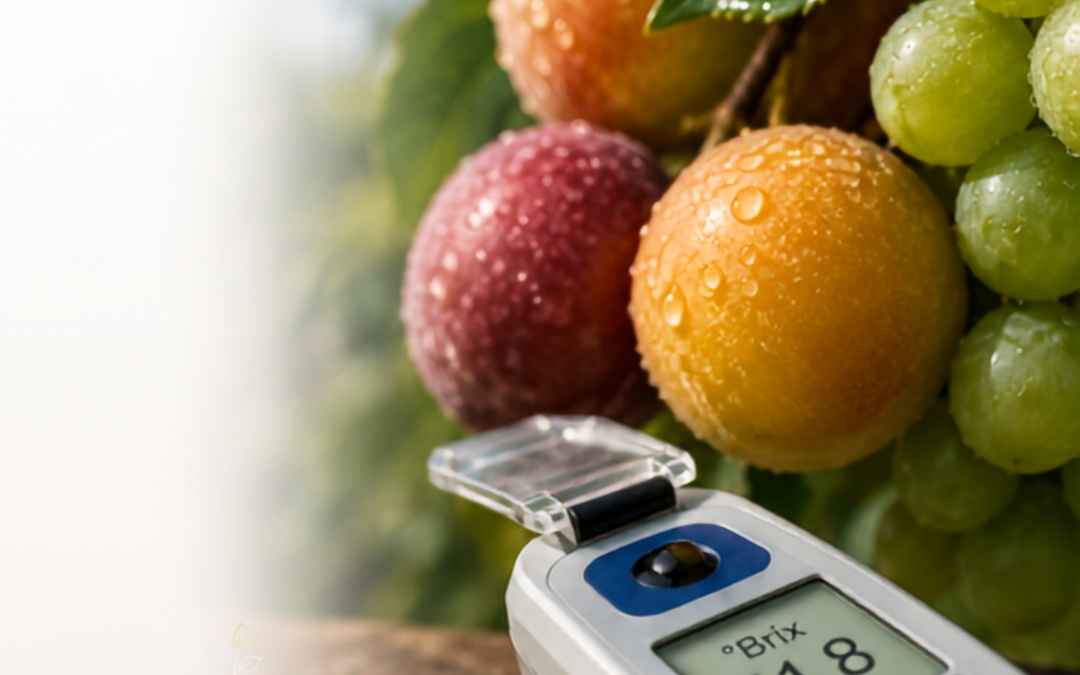
Brix degrees (°Bx) measure the concentration of soluble solids in the fruit, with sugars being the main component.
In crops such as tomatoes, grapes, citrus fruits, stone fruits, and melons, higher °Brix values are generally associated with:
- Greater sweetness
- Better flavor
- Improved coloration
- Increased firmness
- Longer shelf life
- Higher commercial acceptance
For this reason, °Brix is one of the most widely used quality indicators by both growers and marketers.
Why Do Some Crops Fail to Reach the Expected Sugar Levels?
Sugar accumulation is the result of numerous physiological processes that may be limited during the ripening stage.
Among the most common limiting factors are:
Water Stress
When plants experience water stress, photosynthetic activity decreases and the plant prioritizes its survival rather than fruit development.
High Temperatures
Excessively high temperatures can reduce photosynthetic efficiency and interfere with the transport of photoassimilates to the fruit.
Nutritional Imbalances
A deficiency of essential nutrients limits carbohydrate synthesis and transport.
The most important nutrients involved are:
- Potassium
- Phosphorus
- Magnesium
- Calcium
Reduced Photosynthetic Activity
A smaller active leaf area results in lower sugar production available for fruit filling.
Uneven Ripening
When fruits ripen unevenly, significant differences in coloration and °Brix levels can also occur.
The Role of Potassium in Sugar Accumulation
Potassium is one of the most important nutrients during fruit enlargement and ripening.
Its main functions include:
- Promoting sugar transport to the fruit.
- Improving carbohydrate synthesis.
- Increasing cellular osmotic pressure.
- Enhancing fruit size and firmness.
- Improving fruit coloration.
Maintaining adequate potassium levels during this stage helps produce more uniform fruit with higher commercial quality.
Nutritional Strategy to Increase Brix Degrees
There is no single product capable of increasing °Brix levels on its own.
The best results are achieved through a nutritional program tailored to each stage of the crop's development.
1. Promote Sugar Transport with Amino K
During fruit development, a balanced supply of potassium combined with amino acids supports the plant's metabolic activity and improves the movement of sugars toward storage organs.
The combination of these components also helps reduce the plant's energy expenditure during periods of high physiological demand.
2. Maintain Proper Phosphorus and Potassium Nutrition with Fosfo K
Phosphorus plays a key role in the plant's energy processes, particularly those related to carbohydrate synthesis and transport.
Combined with potassium, it helps maintain high physiological activity during the final stages of crop development, promoting more balanced and uniform ripening.
3. Enhance Final Fruit Quality with Brix
During the final stages of the crop cycle, biostimulation becomes especially important.
Brix, developed by Adler Agro, is formulated with polysaccharides, calcium, magnesium, and micronutrients to promote sugar production and accumulation.
Its application helps to:
- Increase sugar accumulation.
- Improve fruit coloration.
- Promote more uniform ripening.
- Increase fruit firmness.
- Enhance the commercial quality of the harvest.
Its use is particularly beneficial in crops where fruit quality directly determines market value.
Benefits of Uniform Ripening
A well-planned nutritional strategy during the final stages of crop development can provide significant agronomic and commercial benefits, including:
- Higher °Brix levels.
- Better fruit coloration.
- More uniform fruits.
- Increased firmness.
- Improved post-harvest shelf life.
- Greater market acceptance.
- Higher commercial value of the harvest.
Conclusion
Producing a high-quality harvest depends on much more than genetics or weather conditions. Nutrition and biostimulation play a decisive role during fruit ripening.
Designing a nutritional strategy that combines specific solutions such as Amino K, Fosfo K, and Brix helps promote sugar accumulation, improve fruit coloration, and achieve more uniform ripening, ultimately increasing the commercial value of the harvest.
Frequently Asked Questions (FAQ)
What are Brix degrees?
Brix degrees indicate the concentration of soluble solids in the fruit, mainly sugars.
Which nutrients help increase Brix degrees?
Potassium is one of the most important nutrients. However, phosphorus, magnesium, calcium, and a well-designed biostimulation program also contribute to better sugar accumulation.
When should products be applied to improve °Brix?
Applications are generally recommended during the fruit enlargement stage and throughout the final ripening phase, always adapting the nutritional program to the crop's physiological needs and growth stage.
Recent Comments